Bath time

Taking the plunge into Halong Bay

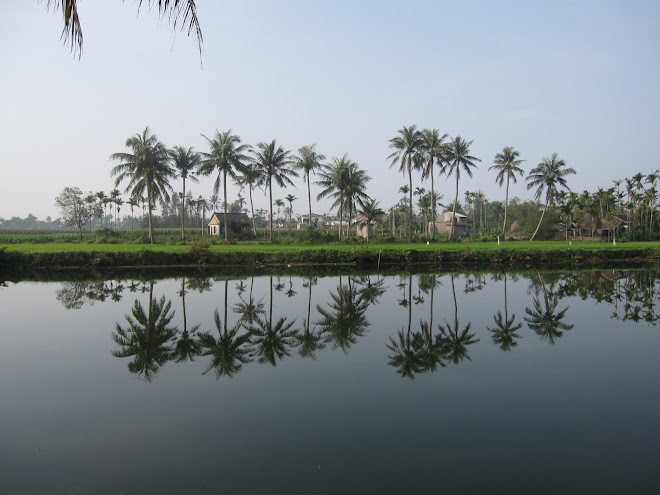
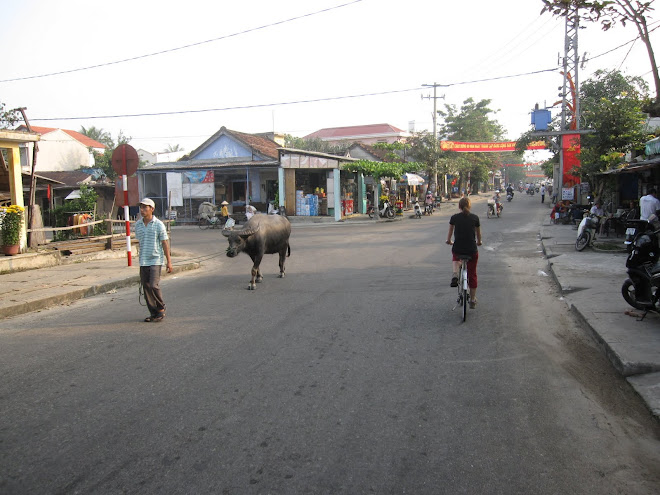
Outside Hoi An

Chasing Cinda to the beach

Thursday, March 11, 2010

After a layover in chqrmingly disfunctional, gridlocked Bangkok, we took an overnight flight to Nairobi, Kenya. We zipped over to the regional airport and got on an 18-seat plane bound for the Masai Mara Reserve. A Masai guide met us at the airstrip and took us to our riverside camp, and on the short drive we saw herds of elephants and grazers, lion cubs, and three sleeping cheetah brothers. Following is Cinda's description of our time there.

-Nate

I will admit that I am completely and madly in love with the elephant. The more I learn about them the more I appreciate their mannerisms, lifestyle and mental and emotional capacity. When observing them in their wild and natural habitat in Maasai Mara they were obviosly unique individuals and ranged from quietly ignoring our vehicle, to playful and engaging. On day 2 of our safari we came across a group of three elephants; one mother with her closeby nursing baby (less than 1 year old as measured by the fact she could still walk under her momma's belly) and a young male who was about 5 years old.


The young boy saw us and perked up his ears and walked straight towards our car. He turned towards us and began putting on a playful show with his trunk wrapping around his right tusk. I was filming this and laughing and he kept on playing until he was finally done then began grazing on grass closer to his mama.

On our last day (#4) we went out for our sunrise drive and again found the large family whose bull was the largest one known on the Mara. He is massive and stands about 10' high at the shoulder with tusks about 4 or 5 feet long. He was estimated to be about 55 years old which is near the later years for these Maasai elephants who, around 60 begin to wear out their 6th set of teeth and then eventually die of starvation.
We stopped in the road which passed near where these animals were roaming. The large male was actively persuing a female who was in estres so our guide knew better than to get down wind of the phermone emitting, dripping giant. The male wandered away from the female and found himself a muddy watering hole to splash mud sunblock on himself. Evidently he had an itch on his backside. Fortunately I was watching this with my own eyes as well as filming it as he wiggled his 6 ton frame down into that mud hole and sat on his bum while flailing about then stood up and flung more mud around and continued on his way. He walked in the direction of our car and showed us he was in charge by his short low grumble. Our amazing Maasai guide, Frederick "Fred" (given name is Olay Ranko), had already anticpated this and we were getting out of his way by the time we heard the grumble.
One thing that is apparent is that elephants are very good mothers to their young. The females travel together with their young close by and their gestation is 22 months(!!!), followed by nursing their babies for another 3-5 years (!!!). Needless to say that they are heavily invested and closely bonded to their family.

The young boys start straying from their group at around 5 years old and then they eventually leave their mothers to find other male bulls to emulate and start looking for females to mate with. The elephant memories are very very sharp (far exceeding that of humans apparently) and they never forget each other. Fred told us of seeing 35 elephants all together the day before we arrived. The elephant families often get together and visit with each other.

So after our amazing four days out in the middle of the bush we flew back to Nairobi for the night before heading to Senegal the next morning. We felt that a direct transition to city hustle would be too stark so we stayed at a bed and breakfast which shares grounds with a giraffe sanctuary. These gentle animals roamed freely and we were given instructions that if they came to the edge of the terrace we could feed them from hand or mouth, however if they stepped up on the terrace we were to swiftly make our way into the house as they are fast moving, sometimes unpredictable, and kick with both front and back legs, as well as head butt.We enjoyed feeding and petting them but they were definitely held in our company by the food pellets we held rather than any other interest.

We had arrived late afternoon so after lunch and a hike through the conservancy forest we headed to the elephant orphanage.We drove through the deeply pot holed roads of Nairobi and saw multiple signs and advertisements for security and barrier patrol which were posted around the residential neighborhoods. We arrived at the David Sheldrick Wildlife Trust (www.sheldrickwildlifetrust.org) grounds and the guard with pink braided hair extensions and a machine gun opened the gates for us.

We drove in and parked and were guided to the neatly kept stalls where te baby elephants were kept at night. They allow the public to visit the elephants for 1 hour in the morning and if you decide to adopt then you are invited back to see you baby put to bed in the evening. Because we arrived after the morning hour, and because it was clear that we wanted to adopt one the owner of the B&B called to see if we can adopt on the spot during the evening visitation. The center limits their public hours to give these animals time and space to adjust to their new environments and because some are still in shock and/or mourning the loss of their mother and elephant families. The reasons for the rescue of these babies is that they lost their mothers to either drought, poachers, or abandonement. In some cases the baby may have fallen into a man made well and become trapped and injured. In these cases the Kenyan government, reserve rangers, or local people call the DSWT to fly in and airlift the animal to the orphanage. There they tend to any injuries and provide care and companionship while the baby deals with it's loss and change of environment.

I was really impressed by the fact that in each outdoor stall there is an loft like wooden platform and a wool blanket where the attendants sleep overnight beside an elephant. If the babies are left alone they cry and pine for companionship. The tenants wake every three hours to bottle feed the baby 6 liters of milk formula around the clock. Each night the attendants rotate to stay with a different animal so they don't get too attached to any single person, as this would cause emotional problems if then that person took time off or was not there. So after visiting and petting the tiny rescue black horned rhino we made our way to the first elephant stall. My heart and Nate's promptly broke in half to see this small 3 month old elephant standing against and carressing his nose along a gray wool blanket which was hung in it's pen to emulate it's mother. The baby seemed disturbed and frusterated as he tugged at the corner of the blanket and paid attention only to this inanimate cloth which did not reciprocate with any of the needs this animal so desired. We wer told this was the newest orphan who had arrived 10 days previously after being abandoned by its mother. Nate and I looked at each other with heavy hearts as we were gently urged to try to visit each of the animals so that we could decide who we would adopt.
We made our way around to see all of the animals: 4 boys, 16 girls, 2 adult rhinos (1 was blind) and the baby rhino. Some of the elephants were playful and curious to smell visiters and wrap their trunks around their arms with the goal of getting you fingers into their toothless mouths for them to suck. I had one baby find and begin playing with the hair tie that was around my wrist after it wrappend it's trunk around my forearm and gently yanked me closer. Some of the other elephants were focused on eating the leaves in their pen, and others were already fast asleep on their sides covered up with a blanket.

Nate and I passed by the first elephant we had seen, Chemi Chemi, twice more but he was fast asleep. The director asked us who we would like to adopt, as it is a one time payment of $50, and since we had only about that much money on hand we had to decide on just one. We both agreed that our little Chemi Chemi needed our help the most at this time. By adopting we will get monthly updates on his progress during the next 3 years in the care of the center. After about 2 years the animal and his attendants will move to the Tsavo National Park and begin to integrate them into the wild population which is the largest single elephant habitat known.

I feel so fortunate to have experienced such a unique and profound connection with all of the elephants I have met so far. It makes me feel hopeful and proud that people with empathy and compassion saw the need to foster these vulerable and gentle giant mammals. And I feel grateful to have the opportunity for playing a tiny role in a program that has such a positive change for the lives of these little elephants. We look forward to hearing of our little one's progress and growth and eventual release back into his natural environment.

xo Cinda

Wednesday, March 3, 2010

Luang Prabang, Laos

We descended into the tiny Luang Prabang airport on a Sunday evening, through a curious haze. As we stepped off the plane, we were hit by a warm, dry wind carrying the smell of burning grass. It turns out that we arrived near the end of the dry season, this being the driest dry season in recorded history. This region is rugged and mountainous, with all available flat ground cultivated for rice and other crops, and many of the gentler slopes terraced for rice and bananas. Some farmers are burning off the leftover stalks from the last rice harvest in anticipation of the next planting that coincides with the rains that will (hopefully) come soon. I think some of these fires have spread to nearby wooded hillsides, quickly burning up steep slopes through the shrubs and grasses at the foot of cultivated teak trees and native forests.

After the noise and hustle and tangy air that stirred memories of 1980s Los Angeles that we experienced in Hanoi, this place is about as peaceful as it gets. Our taxi drove us out onto the peninsula where the main town sits, flanked by the Mekong River on one side and the smaller Kahn River flowing into it on the other. The quiet street was lined with lantern-lit cafes and restaurants and we quickly tucked into some of the best coconut curry soup we'd ever had. Before long we were resting in our quaint hotel with dark hardwood floors and a separate sitting room with a balcony over the street.

We spent Monday morning wandering the well kept gardens and patios of the city and stopped in at the main buddhist temple, where robed monks scurried about. That afternoon, we boarded a van for a short trip to a nearby waterfall. It was a busy tourist attraction, but spread out among dozens of gardens and pools, cascading from one limestone bowl into the turquoise depths of the next. At the base of the largest, upper waterfall, Cinda found a scrawled sign that said "To The Top" with an arrow pointing at a rugged, steep, slippery slope that could hardly be called a trail. She immediately started her special determined march (high knees, clenched fists, many of you know what I'm talking about) in her skirt and flip flops, leaving me to mutter to myself "I guess we're going 'to the top'". After a couple hundred feet of climbing, we reached a plateau and waded across the headwaters to the other side, only to find a sturdy wooden staircase to take us down the other side.

After a few leaps and rope swings into a chilly blue pool, we headed back down to the van, but first stopped at the large enclosure for rescued Asiatic bears. The local organization takes in orphaned cubs whose parents have been poached, and now they live in bear heaven, full of natural streams and pools, hammocks, tires, swings, and platforms, with plenty of room to move about. Being nocturnal, they were just starting to wake up in the afternoon, and had us rolling with laughter as they played pranks on each other, shoving each other when they weren't looking and crashing sleeping bears in their hammocks.

On Tuesday we had big plans. A local group looks after Asian elephants that are retired or rescued from working in the logging industry. An adult elephant can haul or drag as much as 2,000 pounds of lumber at a time, and are often injured or underfed while doing it. Since such logging is now discouraged by the government, many of these elephants instantly have become ravenous, unwanted guests to their former owners. In the pictures we saw of working elephants, it was surprising to see their taught skin and bulging muscles, instead of the usual sagging skin. I could imagine a wild elephant seeing one of these hulking work elephants and saying "Do you work out?"

Cinda was getting dressed, and I could see her carefully choosing her wardrobe in order to impress the elephants (apparently they like rainbow socks). I did think she was going a bit far when she started putting on lipstick though. But it was great to see how exicted she was. Our van pulled into the compound and we got our first glimpse of an elephant and I felt the seat shudder as Cinda quickly bounced up and down with delight. The program we had signed up for was called the 'mahout' class, after the Hindi word for an elephant trainer. The facility offers these tours (for a steep price) so that the eight retired elephants can pay their own way, with much of the expense going towards the 500 pounds of pineapple and and banana leaves each elepant eats every day (washed down with about 50 gallons of water).

Within minutes of arriving, we learned the basic commands for mounting and controlling the big sweethearts, many of them blinded from a snapped logging chain or jungle vine in their former lives. Cinda jumped at the opportunity to be first, and she approached her elephant slowly from the front right side, so the elephant could see her and get comfortable (look for a curious trunk, flapping ears, and swaying. Keep your distance if the elephant freezes!).

"Seung!" Cinda called. The elephant gently raised her front right leg to form a step. Cinda stepped up and using the top of the elephant's ear, vaulted herself onto the elephant's neck. After hauling loads for several decades, Cinda's weight barely registered on this elephant's back. "Pie! Pie!" Cinda called, and the elephant lumbered forward, ignoring the calls of "Sae!" and "Kwa!" ("left" and "right") and heading for the mountain of pineapple leaves at the edge of the clearing. After the elephant ate a few huge stalks, another mahout handed Cinda a bunch of leaves, which the elephant saw and immediately demanded by reaching her trunk over her head and right into Cinda's lap. Cinda complied, and the elephant stuffed the leaves into her mouth while turning to go back to the pile for more.

The real highlight came after lunch, when we took six elephants down to the river. We were in shorts and bare feet, with the insides of our knees near the tops of the elephants' ears and our outstretched hands planted firmly on the top of their skulls, hoping not to go over the bars on the way down the hill. As soon as the elephants stepped into the river, it was obvious that this was the highlight of their day, too. Cinda's elephant immediately got a trunkfull of water and sprayed her with it, and we marched out into the center of the river, which brought the water as high as our feet. Without prompting, my elephant decided to fully submerge herself, trunk and all, with her hind legs stretched out behind her and her front legs in front of her. I was up to my armpits in water, as she stayed under for a good 45 seconds before rising fully out the water. Each of the elephants had their own habits of how they liked to dunk and drink and wheel around, and we scrubbed their giant skulls and ears with rough brushes while they played with each other.

Our final destination was a 10 minute longboat ride down the river, to a nearly dry waterfall that was devoid of tourists. But they did have a zipline course through the treetops, so we woke up the sleeping proprietors and they put us in harnesses. A hundred feet up in giant swaying trees, standing on delicate looking but sturdy platforms, we zoomed through the forest on a dozen wire cables, sometimes lifting our feet above treetops and at one point being instructed to 'brake' on a particularly fast section, using a bamboo stick with a downward-facing crook to pull down on the cable. After a quick dunk in the small pool that remained throughout the year, we were off and headed back to town. A small temple sits at the crest of the hill that anchors the peninsula, so we hiked the 400 stairs and watched the sun set over the quiet city and the smokey valleys beyond.

This brings us to Wednesday morning, which was reserved for our Lao cooking class. After meeting our classmates - a young Belgian couple (Nicholas and Perrine) - we headed to the open-air market to learn about traditional foods. Can you imagine if beef jerkey still had hair on it? Water buffalo jerkey does! Back at the restaurant, we chose several recipes and learned how to prepare them - coconut curry soup, spring rolls, fried noodles, and sweet and sour catfish. Our teacher was great (and patient) and somehow we put together a spectacular lunch, washed down with travel stories and a little lao lao (rice liquor/antiseptic). And now we're up to date and going to pick up clean laundry, getting ready to fly to Kenya after a brief layover in Bangkok. I hope the next post is as filled with good times and unexpected adventures as this one has been. Traveling with Cinda, there's really no doubt it will be...

-Nate

Sunday, February 28, 2010

Hanoi & its scooters, Halong & its limestone

We are now in flight to Luang Prabang, Laos leaving Our week in Vietnam. The only time to take a break and reflect/write is in flight - otherwise there is too much to see and do. Nate's last update was the first morning we awoke in Hanoi when I was feeling ill and sleeping off my stomach pains. During that morning Nate studied the ways of crossing the busy scooter-laden intersections of madly beeping vehicles. He also wisely assessed the hustling pace of the city and decided to choose a few quiet sanctuary- like restaurants, parks and cafes as destinations to head for during my recooperation.
As we were walking north along the lake Nate took my hand and we headed out to cross a crazy intersection. I squeezed his hand and he felt my hesitation but quickly explained that as long as you don't stop no one will be confused and it will all work out. It turns out that is the case and we were frequently traversing the streets with ease. I must say it's easier with 2 people so you each look one direction and it feels much safer with a hand being held. That being said my preference is sitting in a bicycle taxi and just watching it all go by.
Our second day in Hanoi we headed out to Halong Bay which started out with a 3.5 hour van ride. It was comfortable and beautiful as we passed hundreds of plots of rice paddies and watched the farmers work the land. The rice sprouts are young in the season (about month 1 of 3) with some fields growing baby sprouts, some fields had sprounts which were being hand harvested and bundled for transplantation, and some of the plots were being plowed by water buffalo to ready them for planting. The farmers wear round straw hats, and knee high rubbers boots as the Wade in the marshy fields (although there were some bare feet too). Watering is done by a brilliant primative method where bamboo tripods are set up next to the aqueduct and a large scoop is swung so the water is gathered and swung over the small dirt mound into the farmers irrigation channels.
When we arrived at Halong City port we were guided to our "Junk" (boat) where we met 2 German women from Frankfurt and an American woman from New York. We all boarded and looked around the huge wooden boat, with rooms to accomodate 16, and realized we were the only guests are were there to enjoy the boat and 6 staff for 24 hours. I realized that now was the time to feel like royalty transported to another time and land.
We were served an amazing lunch of fresh crab and shrimp along with rice and vegetables as we began motoring through the dreamy misty bay of huge limestone islands (there are about 2000, half of which are named). We laid on the sun deck on chaise lounges and watched the outcroppings pass by. We arrived outside the bay of a fishing village and motored in on our small boat to a floating dock. From there we boarded a small round boat made of thatched reeds and painted, on the outside, with waterproof tar. The boat was rowed by a petite strong local woman with two narrow oars (much like the stoechling boats in the Rhein in Basel). She took us into the floating village where people earned their living by fishing and selling/trading with the mainlanders. They live out in this secluded bay which is protected somewhat from typhoons. Their village center consisted of several different fish farms and a tiny one room primary school where the local children receive their only formal education.
We saw a small 5 year old boy out alone efficiently paddling a boat with all his might. There were no obvious vigilant eyes on him but I am pretty certain he couldn't find himself in too much trouble with such a close knit community. Nate and I laughed when we thought of what the dating scene might be like there!
We motored back to our Junk and had time to take a few plunges from the top of our boat into the beautiful clear water. Our friends took a hilarious photo of us jumping into the bay... Despite the danger of posting a photo of us in bathing suits on this website I think this picture is worth about a thousand words.
After warm showers we sat on the deck and watched the sunset and then sat down to another delicious dinner of crab, calamari, shrimp, taro, veggies and rice. Needless to say we feasted and enjoyed the scenery and the quiet.
After that is where Nate and my experience veered from each other as he was pretty sick most of the night with very similar stomach pains to what I had the few days before. They subsided after a day or so and he was able to make the van ride back to Hanoi but was very relieved when we settled back into our hotel for the night. Now he is fully recovered and we both feel our digestive systems are stronger and ready for the rest of the trip.
Ok, I will sign off here as we are now in Luang Prabang, Laos and its completely amazing here and tropical and (relatively) quiet and peaceful. We have eaten wonderful food and are on our way to a waterfall so I need to run and get ready. Neither of us can believe we are just starting week #2!!!!!

xo Cinda

Wednesday, February 24, 2010

Hoi An to Ha Noi anagramathon

Take a close look at our new profile photo - yes, that is a scooter immaculately tailored in hand-stitched leather. Every square inch of it. If I sat still for too long here, I might end up looking like that...

Cinda awoke at 3 AM on our last day in Hoi An and busied herself with I-don't-know-what until she came back to the room at dawn. She was excited about the sunrise and so I went to the roof with her to see a pale tangerine sun shining weakly through the morning haze. After a quick breakfast we commandeered a couple hotel bikes and pedaled to the beach through the rice patties and hastily constructed concrete buildings. Shrines dot the roadside everywhere you look, and Cinda was particularly fond of one at the edge of a field that included a can of Coke and a beer. I'd never thought of it that way before, but I bet you can really work up a thirst when you're responsible for bringing the rains and good harvests and healthy families all day long. Bottoms up!

Our last errand before leaving Hoi An was at the shoe store. The shoe stores here look like ordinary shoe stores, in that there are racks and walls covered with different styles to choose from. But that's where the similarity ends. Once you find something you like, you take off your own shoes so they can measure your feet, and then pick out the materials and colors that you want. The order is handed to mom and she jumps on her scooter and races off, returning the next morning with a pair of brand new hand-stitched shoes, still reeking of glue and polish. After airmailing our goods back home, we headed to the train.

The women on the train platform in Da Nang stack and organize their wares in precision tiers, a stadium of snacks, dried fish, fruit, and drinks. Yet there are no players on the field in this stadium. Why? Because the Train Station Lady runs a very tight ship, and no one is allowed out the door onto the platform until the train arrives. I found this out the hard way, as I pushed open the door and stepped out to watch the single locomotives pushing a boxcar or two around the yard. I hadn't gotten two steps before TSL grabbed me and shot me a look of disgust and disappointment, folded together and topped with powdered pity. Cinda - as she does - found this very, very, very amusing and proceeded to dare me to go back out on the platform many times, but I have no stomach for such spectacle.

At last our train arrived and the women on the platform had their fleeting moment to sell their goods to the boarding passengers before the TSL once again isolated them. We found our 1st class overnight berth, and without going into specifics, let me say that it did not look like the picture. As we pulled out of the station, we decided to try the age-old traveler's trick to survive such a trip and got 4 ice-cold Heinekens from the dining car. However, we couldn't stay in the dining car, because it was filled with unidentifiable grill smoke (see: carcass car on Chilean trains). We found some backward-facing seats and watched an awesome landscape of steep tropical slopes ringing small palm-lined rice patties that grew right to the sandy beaches at the water's edge. Despite the beauty, we called an audible and stepped off our overnight train in Hue, the ancient capital, and caught a taxi to the airport.

Our taxi driver called ahead to check on flight times from the one-gate airport and confirmed that we could make the last flight. He even brought us into the terminal and handed us off to the ticket agent. Tickets in hand, we stepped out into the pleasant night and sat on the quiet curb, watching the moths in the streetlights and listening to the dance music quitely bumping from the back of a taxi to a throng of drivers who sat on their heels, whispering and laughing. I had been having some problems with digestion - or more precisely, a lack thereof - so Cinda got out her acupuncture needles and gave me a treatment right there in the drop-off zone. No one paid us much mind, but eventually a pair of older ladies in floral print shirts stepped closer, and began pointing at the locations of the needles and the points that Cinda was massaging. It seems one woman was familiar with Chinese medicine, and she recited the names of each point in Vietnamese, while Cinda echoed her in Chinese. And based on the points that Cinda was treating, the woman looked at me and circled her belly with her hand while blowing out her cheeks, apparently the international sign for constipation. I sheepishly nodded and she smiled sympathetically.

We arrived in Hanoi with only enough time for a quick walk and a bite. I ordered a pizza which was surprising good, given that it was essentially a pile of vegetables and a sprinkle of cheese on a thin cracker (like the 'serving suggestion' on a box of Triscuits). And now I'm wandering the Old Quarter of Hanoi on a hazy morning while Cinda rests, and marveling about how much Krazy Glue the shoeshine guy just put on my shoes.

-Nate

Tuesday, February 23, 2010

settling in; Hoi An

We are making the best use of our days and now calculating our early to bed and early to rise times based on when the cafe across the road turns off its loud Vietnamese music at 10.30pm. This quiet also marks the sudden halt of the whizzing and beeping of the scooters zipping by. Then it all quickly fires back up at 6am, which is when all the hotel guests seem to rise and make their way to breakfast. Its funny to me that here the use of the horn is more like a bantering of conversation rather than an act of aggression. Even on the highway, where there is one lane for cars and one for scooters/bikes) a car can travel behind a truck and beep its horn for 1 minute straight before the trucker finally decides to slowly veer to the right. There is no frusteration or agrression between either the 'passer' or the 'passee' - its just common practice, as though they were just chatting with one another before moving on.

Today is our 3rd and last day in Hoi An; it is beautiful here and we have well contributed to the economy of the skilled tailors and shoe makers, and eaten very well with plenty of fresh seafood and spring rolls. Yesterday we took a 3 hour side trip to My Son which is about a 1 hour drive away. Its an amazingly beautiful site of Hindu temples built of bricks with figures carved into them which was built in about the 9th century. On the drive out there we passed thru small clusters of towns and by a surprising amount of cemetaries, or single/double graves which were raised above the rice patties. The burial sites look celebratory and resemble a well-tended brightly painted carnival.

I certainly feel like I'm on vacation as I find myself enjoying the traveling between places as much as I do arriving at the destinations. The 10.5 hour flight from San Francisco to Tokyo passed very quickly as I started a new novel (The Spirit Catches You and You Fall Down) and watched the Michael Jackson documentary: This Is It. The 6.5 hour journey from Tokyo to Ho Chi Mihn City (HCMC) seemed like the right time to get some sleep. Luckily I was determined and small enough to curl up between the arm rests of my seat, and Nate (unbenownst to me) used me and my neck pillow as a cushion and we both were able to get some shuteye. There is no place I would have rather been. Traveling widens the boundaries of my mind and gives me new perspective on everything. My brain feels like its softening and my body feels like its unwinding into a new state of being.
We are so lucky to be taking this trip.

When we arrived in HCMC the sound and presence of all the scooters became more dense as we neared the city. Both Nate and I were relieved to see both scooter drivers and passengers wearing helmets, so it seems to be a law here though we have yet to see any law enforcement anywhere. In the day it became more evident that the helmet law doesn't apply to children who are either propped against or afixed to the front of the driver or sandwiched between as many adults as can fit on the seat. The max we've seen is a family of 5. The only universal precaution for both children and adults on the scooters is a cloth face mask which covers the nose and mouth, and comes in many different colors and fabrics. The face mask here, like in China, is a widely accepted fashion accessory.

Children seem to be very well loved and cared for here with their parents constantly laughing, hugging, and speaking with them. On the 6.5 hr flight into HCMC a woman had her 1 year old on her lap for the entirety of the trip and let him stretch from her arms over her stretch out crossed legs. The boy slept quietly for the entire flight and then woke up in time to deboard without a single peep.

Tomorrow we will try to have a quick bike ride to the beach before getting our things together and heading back to Da Nang to catch the train up to Hanoi. We leave at 1.30p and get into Hanoi at 4.30a (ouch). The first part of the trip, which will be in the daylight will be very scenic and goes along the coast. We are optimistically thinking the sleeper car will be sleepable...but will plan to keep our headlamps and novels close at hand in case it's not! Once we arrive we'll figure out our plan to get out to Halong Bay and see about taking an overnight boat to explore the phosphorescent waters there. The weather has been amazing, comfortable both day and night, so we'll see what its like in Hanoi which is a bit further north and probably cooler than here.

With any luck in Hanoi we will find a computer to download and post our photos.

I hope you are all well! Traveling and being in such different surroundings always reminds me of how much I have to be appreciative of in my life..especially my friends and family.

xo, Cinda

Monday, February 22, 2010

Welcome to Vietnam

Cinda and I spent a seemingly endless Saturday afternoon chasing the setting sun toward Tokyo, watching movie after movie and chatting in the galley over cups of box wine with the flight attendants about how to deal with the stresses of unpleasant passengers (1. anti-depressants; 2. buddhism). After a quick stroll through the Tokyo airport (cubist lounges, spas, fried shrimp ebi burgers at McDonald's), we were back in the air and bound for Saigon, known (only) officially as Ho Chi Minh City, after their mustachioed and goateed smiling former president.

We had been advised and warned about the hectic pace of Saigon's streets, but we arrived near midnight on a Sunday night, a time which acts as a beekeeper's smoke in calming the hive. Instead we rolled slowly through half-dark and nearly empty streets, the frequent portraits of Ho Chi Minh curiously mirrored by one of advertising's biggest dumb-luck successes in all history - Colonel Sanders and his mustache, goatee, and warm smile (the Colonel plays well in China, too, where he looks to me like Confucius' little brother).

It was after midnight in Saigon but 8 AM back home, so we were wide awake and ready to stroll. The warm night was enveloping ("like a blanket" said Cinda) as we walked through festive boulevards still vibrant with fresh flowers and paper lanterns from the Lunar New Year celebration last weekend. But restaurants were hard to come by, so we settled on Chinese food at a brightly lit aquarium with tables (Tiger333 beer, fried rice and dumplings). Finally we forced ourselves to sleep.

Monday morning was quiet and comfortable, but as the light gathered, so did the hum of the hive, embodied by the put-put-putter of hundreds of low horsepower scooters. The scooter-to-car ratio lies somewhere around 30 to 1, with all manner of business conducted from the saddle (DHL, carpool, feather duster sales, block ice delivery, business suits headed to the office, sleeping, eating, frolicking). We used our short morning before our flight to visit the War Remnant Museum, which houses an array of U.S. hardware in a dusty courtyard, from jets to artillery pieces to a tracked flame thrower. Inside the open air building were a host of displays about the war itself and the surrounding political situation, both in Vietnam and around the world (all from a not-quite-familiar perspective). There were notably several American men in their 60s there who would have been in their 20s during the war and were likely making a difficult journey back to a place they had been a lifetime ago.

After a short flight to the central coast town of Da Nang, we were shuttled out to the small riverside town of Hoi An, passing along the way the 30 km stretch of coast known collectively as China Beach - a favorite R&R for American troops during the war. However, we never actually saw the beach, because of the non-stop progression of huge, exclusive resorts that are emerging from the sand, in various states of completion and preventing access to all but the cucumber eye mask crowd.

Hoi An's streets are often narrow and winding, littered with flowering trees and lit with overhead lanterns. Known for good food, the town is famous for fine clothes, and within hours I found myself being measured for a tailored suit in the loft of a 19th century warehouse-like building, while Cinda flipped through magazine and catalog cutouts she had brought along and discussed how to bring them to life with another tailor. With the jetlag finally catching up with us, we spiraled our way back through alleyways and over covered bridges until we were back at the hotel and among the friendly staff ("You don't have to take your shoes off at the door - you're number one!"

-Nate

Saturday, February 20, 2010

Testing 1-2-3...

Cinda and I are getting ready to go to the airport. Next post will be from Vietnam!